F-35
Composite Edge of Part Machining
NCDMM
Project No. 05005602
PROBLEM / OBJECTIVE
Lockheed Martin Aeronautics Company (LMAC), Fort Worth,
TX, the world-class manufacturer of components for the F-35
Joint Strike Fighter (JSF), experienced difficulties in
machining advanced composite wing skin material for the
JSF. With tool life lasting only nine (9) linear feet at
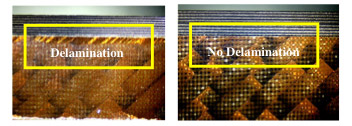
one-third the total material thickness and excessive delamination
of the composite material, existing tooling and processes
were unable to produce quality components efficiently.
Because of the growing demand for F-35 composite components,
tight manufacturing schedules and limited machine time to
conduct tool testing on new composite materials, LMAC called
upon the National Center for Defense Manufacturing and Machining
(NCDMM) to provide a more efficient machining solution.
The team's goal was to improve tool life and eliminate delamination
of the outer edge.
Wing
Skin Composite Material
ACCOMPLISHMENTS
/ PAYOFF
Process Improvement
NCDMM initiated the development of a solution by building
a vacuum test fixture (to LMAC's specifications) to hold
the composite test panels provided by LMAC. Solution development
started with the evaluation of multiple cutting tool geometries
at varying application parameters. Once cutter geometries
and their associated cutting forces were determined, tool
life and delamination were measured and evaluated. These
test results lead to the in-depth understanding of the three
key elements needed to provide the best solution - tool
geometry, tool material and the proper tool coating.
The NCDMM, with the assistance of it's Alliance Partners,
was able to combine key technologies and develop a tool
that dramatically increased tool life and eliminated costly
edge delamination.
Test coupons were ultrasonically inspected by both an external
source and LMAC to verify the integrity of the parts - all
with successful results.
The tool life increased from nine (9) linear feet at one-third
the material thickness to fifty-seven (57) linear feet at
full material thickness.
Implementation and Technology Transfer
The following implementation and technology transfer steps
have taken place:
- Process verified and implemented at LMAC Ft. Worth
- Three state-of-the-art technologies from three Alliance
Partners combined for an ultimate solution
- Proven best practice can now be applied to the JSF (and
other aircraft) composite sections
Expected Benefits
LMAC can now machine a complete wing skin using only 2 cutting
tools - one to rough and one to finish.
- Increased cutting distance more than 6x (from 9 to 57
linear feet) at full material thickness
- Reduced number of tools per wing skin from 24 to 2
- Reduced programming time and increased productivity while
reducing scrap
Cost benefit: $80,000
per aircraft. LMAC is expected to manufacture a total of
2,783 F-35 aircraft, which equates to an estimated savings/cost
avoidance of $222.6M over the projected F-35 build.
Note: Cost and timesavings associated with scrap reduction
not included in the calculation above.
TIME LINE / MILESTONE
Start Date: February 05
Recommendations Made: November 05
PROJECT FUNDING
NCDMM / LMAC: $105K
PARTICIPANTS
Amamco Tool Company
McCullough Machine
Diamond Tool Coating
RNDT, Inc.
Kennametal lnc
Lockheed Martin Aeronautics Co., Fort Worth, TX
For additional information concerning this project, contact
the NCDMM at www.ncdmm.org









 t 716.693.5050
 f
716.693.5045
f
716.693.5045 e
e